

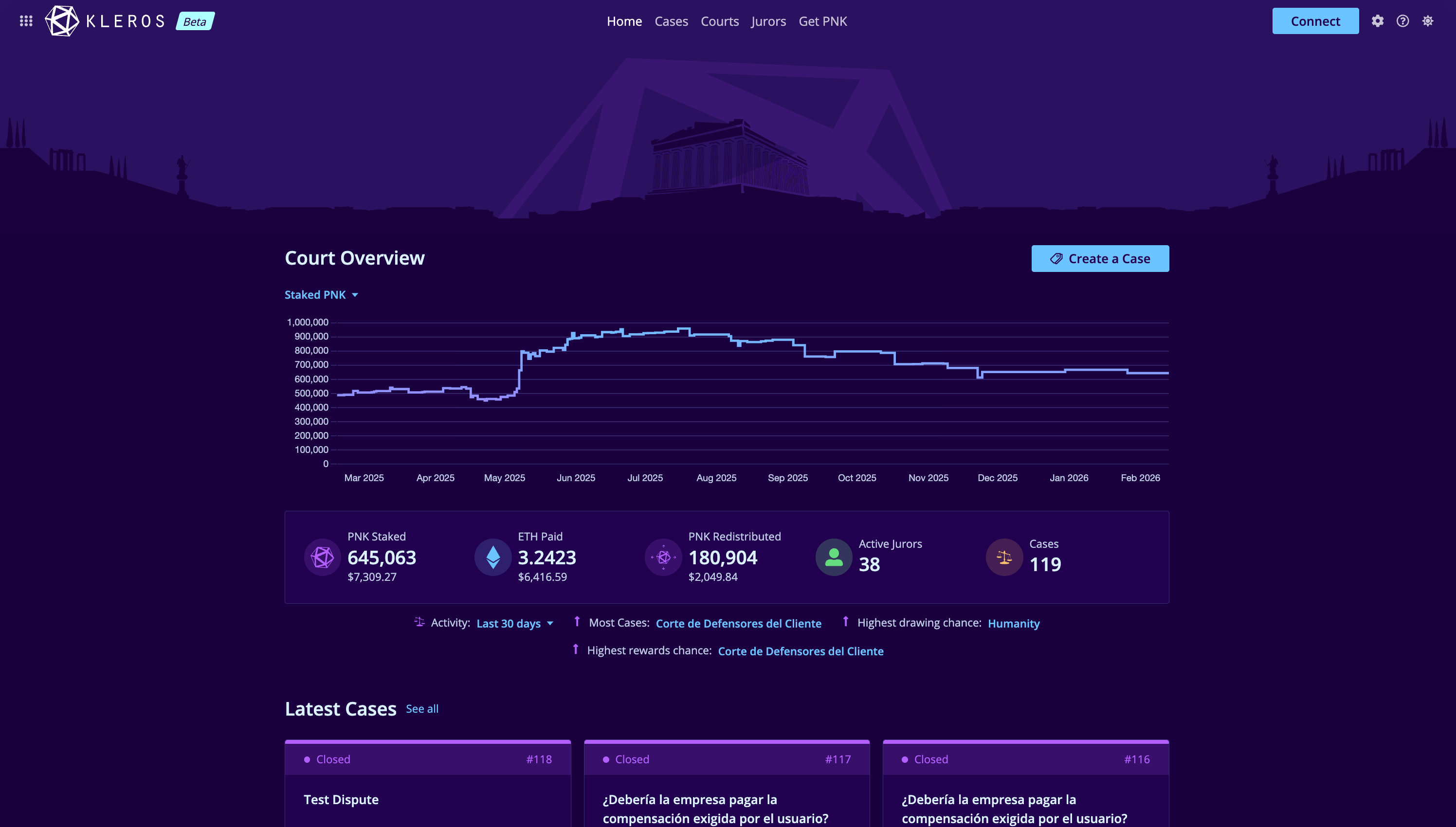
Kleros Court
Kleros Court is a decentralized dispute resolution protocol that provides arbitration services for smart contracts and decentralized applications. It works by randomly selecting jurors from a pool who are incentivized to resolve disputes honestly through a crypto-economic mechanism based on game theory. Think of it as a decentralized judiciary for Web3. When a dispute arises, jurors are randomly drawn, they review evidence, vote on the outcome, and the majority decision is enforced-all without centralized intermediaries. Kleros Court comes in two versions. V1 is the production-proven protocol running on Ethereum since 2018. V2 is the next-generation upgrade on Arbitrum with a modular architecture.V1 - Production Protocol
Court V1 launched on Ethereum Mainnet in 2018 and has resolved over 1,500 disputes. Its core smart contract is KlerosLiquid, a single (monolithic) contract that combines juror staking, random selection, voting, and dispute management.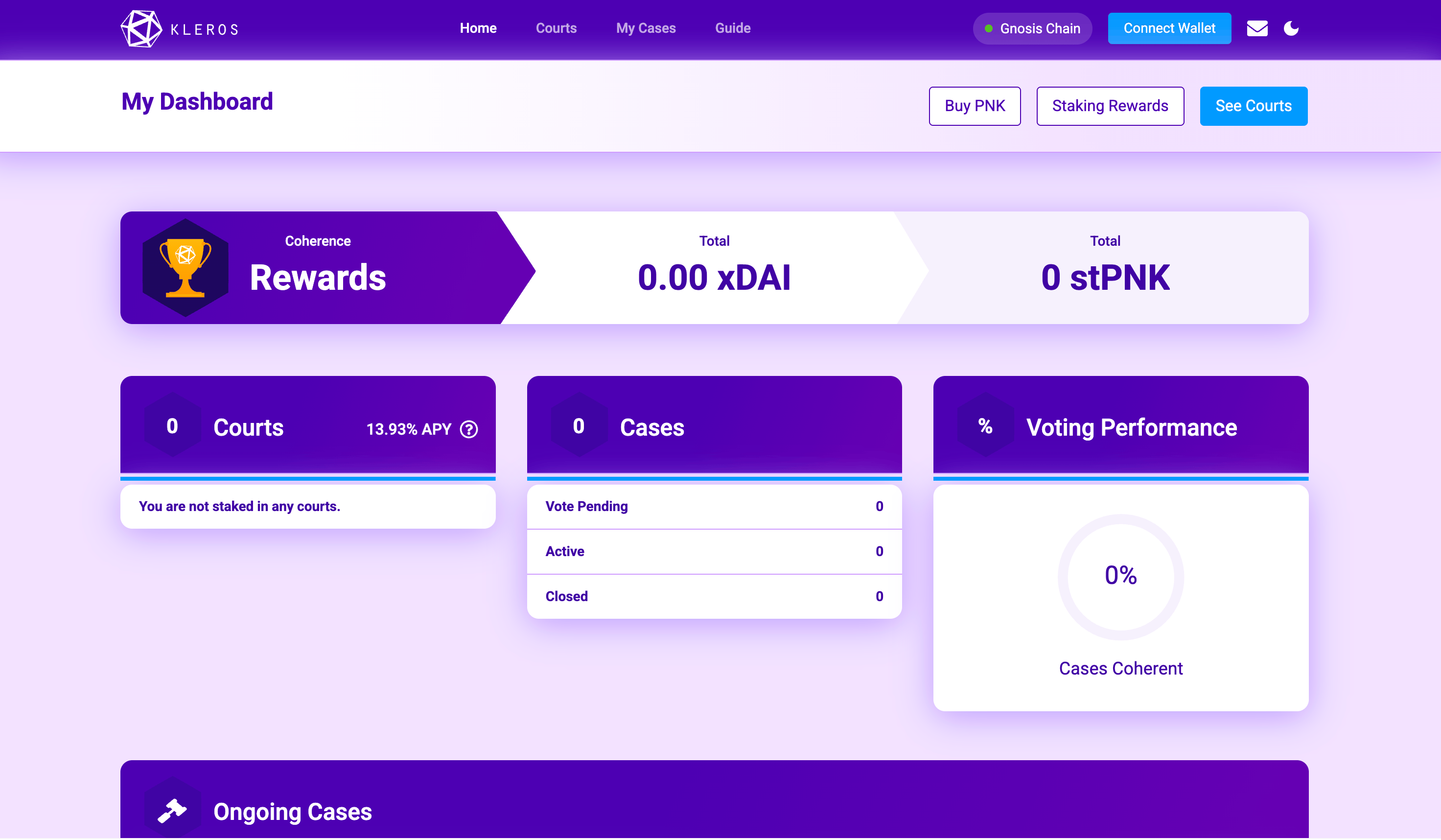
Jurors stake PNK directly from their wallet in a subcourt, are drawn at random with probability proportional to their stake, then commit and reveal their votes on the submitted evidence. Coherent jurors are rewarded; incoherent jurors lose part of their stake.
V2 - Next-Gen Upgrade
Court V2 runs on Arbitrum L2 and replaces the monolithic contract with a modular design: KlerosCore coordinates disputes, the SortitionModule handles juror selection, and pluggable DisputeKits provide the resolution mechanism. Cross-chain disputes are relayed through the VEA bridge.Key Capabilities
Random Juror Selection
Jurors are randomly drawn from stakers, weighted by their PNK stake
Crypto-Economic Incentives
Honest voting is rewarded; incoherent votes result in stake slashing
Hierarchical Courts
Specialized courts for different dispute types with appeals to parent courts
Modular Dispute Kits
Pluggable resolution mechanisms: Classic, Shutter (encrypted), Gated (SBT-eligibility), and GatedShutter
Cross-Chain Support
Disputes from any EVM chain resolved on Arbitrum via Vea bridge
Trustless Execution
Rulings are enforced automatically by smart contracts
How It Works
At its core, Kleros works through a simple yet powerful process:1
Dispute Creation
An application encounters a contentious situation and creates a dispute in Kleros, paying arbitration fees.
2
Juror Selection
Jurors are randomly drawn from those who have staked PNK in the relevant court. Selection probability is proportional to stake.
3
Evidence & Voting
Jurors review evidence submitted by both parties and cast their votes during the voting period.
4
Resolution
The majority decision is enforced. Coherent jurors are rewarded; incoherent jurors lose a portion of their stake.
The Incentive Structure
The system is designed so you don’t need to trust anyone:- Jurors are incentivized to vote honestly (or lose their staked PNK)
- Disputants pay fees only for resolution, with no protocol commission
- Appellants can challenge rulings by funding additional rounds
Core Components
Who Uses Kleros Court?
- DeFi Protocols resolve oracle disputes, liquidation challenges, and governance conflicts
- Prediction Markets settle market outcomes with decentralized arbitration
- Escrow Services release funds based on impartial third-party rulings
- DAOs handle contributor disputes and proposal challenges
- Insurance Protocols adjudicate claims without centralized authority
- NFT Marketplaces resolve authenticity and ownership disputes
What Changed in V2
V2 keeps the same crypto-economic model as V1 and changes how it is implemented and where it runs:Kleros V2 is currently in beta with 100+ disputes successfully processed. The system is undergoing internal review and external audits.
Current Status
As of the May 2026 development update:- Court V2: the partial-coherence dispute kit was merged, and contract simplification across dispute kits was merged (June 2026).
- Court V1: April staking rewards were shipped in the rewards exporter.
What’s Next?
How It Works
Deep dive into the dispute resolution process
Court Hierarchy
Understand the court structure and specialization
Appeals
Learn how appeals and escalation work
V2 Architecture
Design principles, multi-chain vision, and security model
Quick Links
Launch Court
Open the Kleros Court application
Become a Juror
Step-by-step staking and voting tutorial
Contract Addresses
Court V2 deployment addresses
Kleros SDK
Integrate Kleros into your application